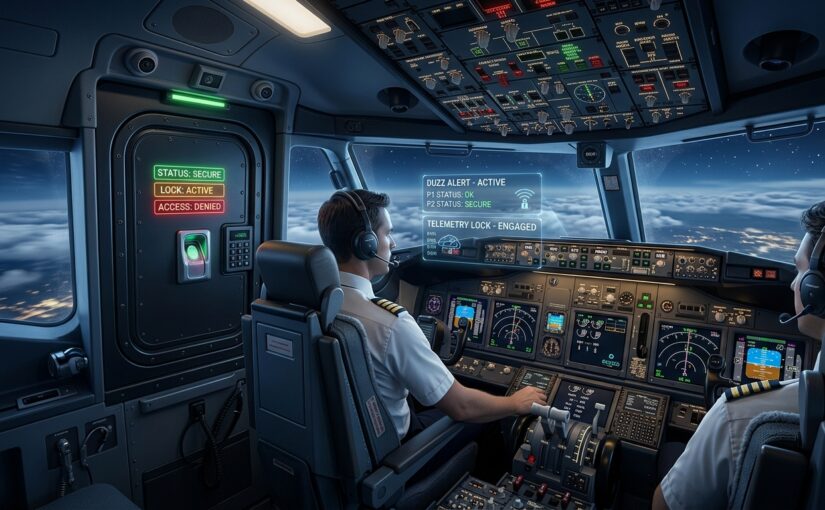
On September 30, 2026, Flydubai Flight FZ1073 was cruising toward Tel Aviv with 174 passengers aboard when a nightmare unfolded at 35,000 feet: the first officer grabbed the cockpit’s emergency crash axe and attacked the captain from behind.
What followed was a desperate, bloody struggle on the flight deck. The captain suffered catastrophic injuries, but with his final ounce of strength, he dragged himself across the floor and pulled the latch to unlock the armored cockpit door.
Off-duty crew and passengers heard the screams, stormed inside, subdued the attacker, and managed an emergency landing in Tabuk, Saudi Arabia. If that captain hadn’t reached the latch in time, the plane would have slammed into the ground. Nobody inside the passenger cabin could have broken in to save them.
That terrifying near-miss exposed a glaring flaw in modern aviation security. It’s a problem familiar to every cybersecurity engineer: The Fortress Paradox. When you build an impenetrable wall to keep the outside world out, you accidentally lock everyone inside with the threat.
How 9/11 Created a Zero-Trust Nightmare
After September 11, international regulators mandated bulletproof, Kevlar-reinforced cockpit doors with electronic deadbolts. The rule was clear: hijackers must never, under any circumstances, force their way into the flight deck.
It worked against external hijackers. But it created a massive blind spot: the insider threat.
We saw it with Germanwings 9525 in 2015, where the co-pilot locked the captain out during a bathroom break and flew an Airbus A320 into the French Alps. We saw it on FedEx 705 back in 1994, where a deadheading flight engineer tried to slaughter the crew with claw hammers. And now, Flydubai 1073.
Right now, if one pilot decides to attack the other, the victim’s only lifeline is physical strength. That is an unacceptable engineering failure in 2026. Here is how modern technology can solve it.
1. Independent Silent Duress Switches (The Bank Teller Model)
Every bank teller has a silent foot-switch under their counter. Cockpits have transponder squawk codes (like 7500 for hijacking), but dialing a 4-digit code into a radio panel while someone is swinging an axe at your head is impossible.
Both pilot seats need concealed, tactile duress switches—either built into the rudder pedal assembly, under the armrest, or behind the sidestick.
- Instant Alert: A single 2-second press immediately transmits a high-priority duress signal to Air Traffic Control (ATC) and sounds a silent visual alert on the flight attendant interphone panels.
- Door Latch Override: Tapping the emergency switch automatically disarms the cockpit door’s internal deadbolt lock for 60 seconds, allowing cabin crew to enter using their emergency keypad PIN without waiting for pilot approval.
If Captain Machchhar had a floor switch, he wouldn’t have had to crawl across the floor while bleeding to let help in.
2. Smart Retention & Interlocks for the Crash Axe
Every commercial airliner cockpit carries a heavy metal crash axe behind the pilot’s seat. It’s mandated by international regulations for firefighting, prying open jammed panels, or chopping through cockpit walls during an emergency egress.
Think about the absurdity of this setup: a deadly weapon hangs within arm’s reach inside an enclosed, locked space with zero monitoring.
The fix is simple physical security:
- Magnetic Interlock Sensors: The axe should sit in an electronically monitored holster. The second the tool is unlatched during cruising flight, an audible alarm triggers in the flight deck and sends an alert to the cabin chief.
- Impact & Depressurization Release: Keep the axe locked behind an electronic latch that only releases automatically when cabin pressure drops, on fire detection, or upon impact sensors—or via a dual-pilot confirmation button.
3. Cryptographic Remote Ground Unlock (Air-to-Ground 2FA)
Whenever you mention remote-controlling anything on an airplane, aviation engineers cringe. And with good reason: nobody wants hackers breaking into an aircraft via SATCOM Wi-Fi.
Remote door unlocking doesn’t need to touch the flight controls. It can operate on a completely air-gapped, zero-trust hardware architecture.
Here is how it can work securely:
- Dual-Custody Key Authorization: Just like launching a missile or transferring billions in corporate funds, a ground unlock requires two digital cryptographic signatures—one from the airline’s Chief Flight Dispatcher and one from National Air Traffic Control.
- Hardware Security Module (HSM): An onboard cryptographic chip verifies the signed command over SATCOM (ACARS). Once verified, the chip pulses a 12-volt relay directly to the door solenoid, dropping the lock.
- Zero Control Surface Access: The circuit connects only to the door latch magnet. It has zero bus connection to the autopilot, fly-by-wire computers, or engine FADEC. Even if a bad actor spoofed the key, all they could do is pop a door latch—not steer the plane.
4. Autonomous Envelope Protection (Emergency Autoland)
During the struggle on Flydubai 1073, the aircraft plunged over 16,000 feet in roughly 30 seconds. In Germanwings 9525, the co-pilot dialed the autopilot altitude down to 100 feet.
General aviation already solved this with systems like Garmin Emergency Autoland. With a single button press—or when flight computers detect an incapacitated pilot—the system calculates terrain, communicates with ATC, flies the plane, lowers the gear, and lands automatically on the nearest runway.
Adapting this to commercial airliners provides the ultimate safeguard: if an uncommanded dive or violent flight deck telemetry is detected while an emergency duress switch is active, the aircraft overrides irrational flight inputs, levels off at a safe altitude, and squawks an automatic MAYDAY.
The IT Takeaway: Security That Doesn’t Blind Itself
In IT, we learned long ago that perimeter security alone is a death trap. If your firewalls keep the world out but you grant unrestricted, unmonitored privileges to someone sitting on the internal network, you haven’t built security—you’ve built an illusion.
Aviation fixed the external threat in 2001. Now it’s time to fix the inside. A captain shouldn’t have to survive an axe strike and drag themselves across the floor just to get someone to open a door.